

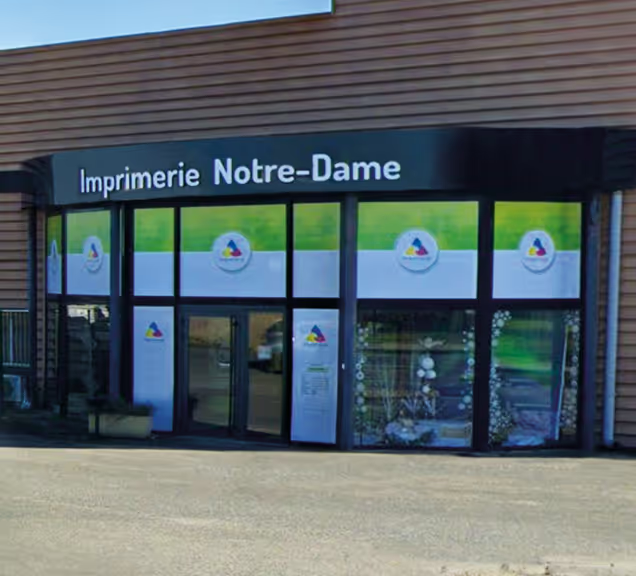


Imprimerie Notre-Dame is specialized in the printing of papers and labels for professionals, based in Bourges. The company, which saw its payroll increase rapidly, now has around fifteen employees.
Frédéric, manager of Imprimerie Notre-Dame, explains to us how he manages the schedules of his teams thanks to Skello.
Before Skello, Frédéric managed schedules manually, but the growth of the company and the increase in staff made this task complex. The company needed better organization to ensure new time slots and monitor working times.
“We opened more time slots, which posed more complications in terms of scheduling. We also have employees who have personal constraints and who must be taken into account. And then we could no longer keep track of the time when employees arrived or left on break.”
The company also needed a clear vision of the hours worked by each employee, in particular to anticipate periods of high activity and limit unnecessary overtime.
“Even if the vast majority of us are in 35 hours, about 3 or 4 months of the year, we go from 35 hours to 39 hours or 40 hours per week, so we need to anticipate the schedules and see who is in advance and who is not.”
Frédéric quickly saw the added value of Skello in terms of schedule management. The automatic countdown of hours allowed the printer manager and his team to optimize schedules and avoid overtime.
“What was quick to get started was the visibility in terms of schedules. You can easily find out what you did in the previous weeks, assess who worked how long and what's left to do at a glance.”
Frédéric tells us that the installation of the clocking device has strengthened the punctuality of employees, and he is not the only one: according to our recent survey*, employee delays and associated costs are on average reduced by 2 thanks to the clocking device.
“We are less behind schedule than before. That's since we put on the badger.”
Skello has also strengthened employee autonomy and accountability. Each employee accesses their schedules via a secure personal space, thus strengthening trust and fairness within the team.
“The code is on their personal space, even I don't have access to it. It makes them responsible: they say to themselves, it's really not me who's behind adjusting the schedules.”
Regarding the reception of the teams, “they did not see it as a tool for policing”, he assures, and even adds that it has established a certain form of fairness.
“In a workshop where everyone is supposed to arrive at the same times, it's true that it rectifies inequalities and puts everyone in the same position.”
Despite a necessary period of adaptation, Frédéric and his team quickly noticed the time savings brought by Skello and plan to train more to fully exploit the tool.
**Survey conducted in February 2024, to which 180 customers responded. *
Imprimerie Notre Dame, based in Bourges, offers a wide range of printing services for professionals and individuals. Labelled Imprim'Vert, it is distinguished by its eco-responsible commitment by using ecological inks and recycled paper.




.avif)