.avif)


A job to be filled, resumes that are slow to arrive, interviews that follow one after another, but still no one in place. If you work in the restaurant, hotel, health or construction industries, this situation is surely familiar to you. Recruiting field teams is a real challenge for companies. In a context where skilled labour is becoming scarce, with frequent employee turnover and difficulties in attracting and retaining talent, HR managers and managers find themselves facing an ongoing headache.
Between the need for Recruit quickly, administrative constraints and operational pressure, current processes are showing their limits. Recruiting often remains ineffective, leading to high costs, a disorganization of teams And a degradation of the customer experience.
How can these recurring difficulties be explained? And above all, What solutions finally make it possible to optimize the recruitment and integration of field teams?
A market in tension: the headache of recruiting field teams
One structurally high frequent employee turnover
The sectors mentioned above are marked by higher than average precariousness, often short contracts and significant employee mobility.
A turnover rate of less than 5% in an organization is generally considered to be very low. A turnover of between 5 and 10% is considered low, while a rate of up to 15% is considered average. Above 15%, we are talking about a high turnover.
In France, INSEE estimated in 2021 that the average turnover rate in a company is 15%, all sectors combined, but this figure can easily exceed 50% in the hotel and catering sector. According to a DARES study, only two-thirds of employees in this sector keep their job for more than a year.
Why is there such a high turnover of employees?
A study conducted by Deloitte shows that 66% of millennials are considering leaving their current job in the near future. In general, 36% of open-ended contracts are broken in the first year. Several factors explain this high turnover of field teams, which make employee retention particularly difficult in these sectors.
- Demanding working conditions : staggered schedules, an intense pace, a heavy workload...
- Unattractive salaries: Faced with salaries that are often low, employees do not hesitate to change employers for a few euros more.
- A lack of development prospects: the lack of clear career progression pushes many employees to look elsewhere.
- Strong seasonality : the instability of personnel needs makes it difficult to retain teams (short contract, low hourly rate, etc.)
Severe consequences for businesses
Each departure represents a cost: you have to recruiting, training and integrating a new employee, which requires time and resources. At each rotation:
- Recruiting and training costs are exploding, directly impacting profitability.
- Teams are disorganized, which impairs operational efficiency.
- The customer experience is deteriorating, because understaffed or trained staff perform less well.
In this context, attracting and retaining talent is becoming a strategic issue. But are current tools really adapted to these realities?
ATS, recruitment solutions, but with limits
ATS are not enough to solve the problem
One ATS (Applicant Tracking System) is a software used during recruitment and application management that allows you to centralize and monitor recruitment processes. It allows you to publish offers as well as receive, sort and manage applications, schedule interviews and follow the selection steps. However, although it optimizes certain stages of recruitment, it has several limitations.
Disconnection with HR and operational tools
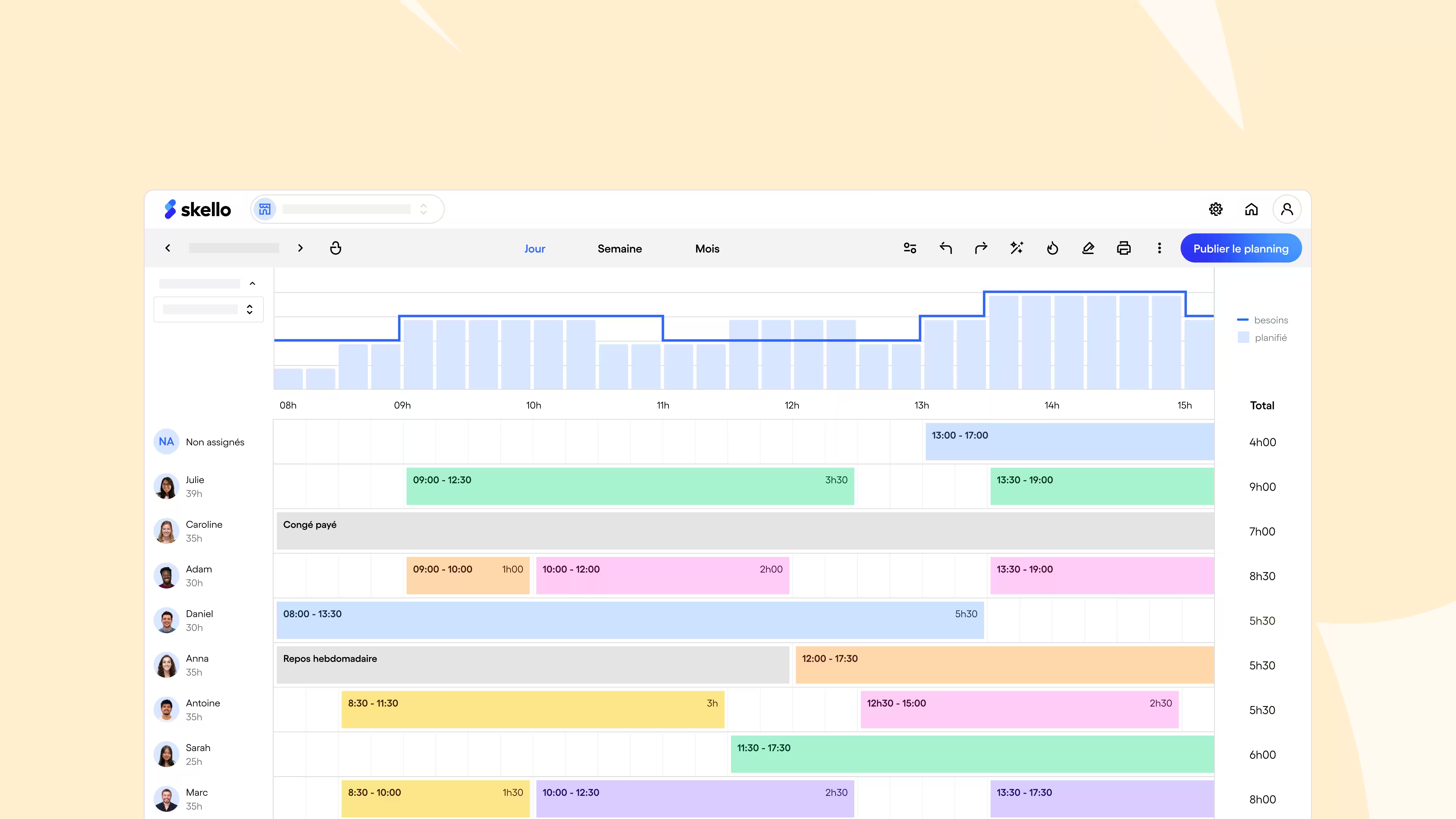
One of the main shortcomings of ATS lies in their disconnection with other HR and operational tools used in the business. For example, managers and HR managers often have difficulty in anticipating recruitment needs based on business fluctuations. Without a direct link between the recruitment system and the schedule management, there is a risk of understaffed Or of overmanning, which disrupts the fluidity of daily operations.
Employee integration issues
ATS are primarily designed to manage applications and not to ensure smooth employee onboarding. Once a candidate is selected, information is not always transferred correctly to HR management systems, which can lead to frequent errors.
One double entry required data in multiple tools not only results in risk of error but also a considerable loss of time, increasing the administrative burden on HR teams. This slowness in the integration process is detrimental to operational efficiency, especially when field teams need to be up and running quickly.
Thus, although ATS have made improvements in the management of applications, they do not solve all the challenges associated with the rapid and effective integration of field teams, leaving significant gaps in the fluidity of the recruitment process.
A solution to streamline the recruitment and integration of field teams
Skello, a key lever to optimize this synergy
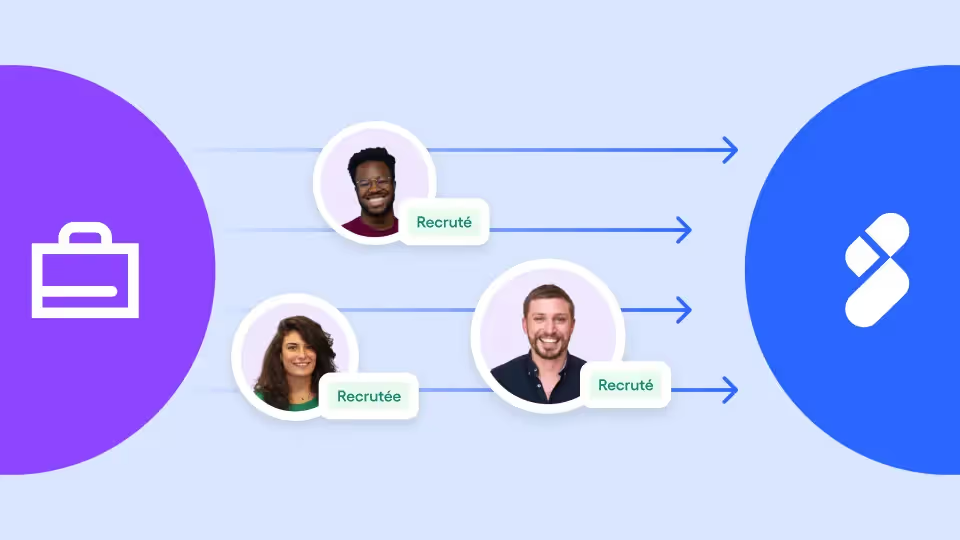
To solve the problems related to the management of the recruitment and integration of field teams, Skello is positioned as an essential solution. By integrating directly with software ATS suchlike Layan and Softy, Skello simplifies the transition from recruitment to the integration of new employees, thus creating a synergy between HR and operational tools.
Plan your hires and avoid staff shortages
Thanks to Skello, you anticipate your personnel needs according to the activity and thus avoid staff shortages that can destabilize your teams. You are then guaranteed to have a team ready to take on all your challenges, without interruption.
Post your ads and recruit more quickly
By centralizing all applications and recruitment processes thanks to its partner tools, Layan and Softy, Skello makes it possible to simplify the selection of candidates and to save precious time. By connecting your recruitment tools with those for managing schedules, coordination is effortless and guarantees a better match between the profiles recruited and the operational needs of the company.
HR data transfer for smooth integration
Once the candidate is selected, Skello allows you to automatically transfer HR data directly from your ATS, eliminating the need to re-enter information. This seamless integration and guarantees a quick start, during the transition from candidate to employee and allows immediate planning.
Thanks to this solution, Skello facilitates not only the recruitment, but also the integration of field teams, bringing real fluidity in your HR and operational processes.
Recruiting field teams remains a major challenge for many companies, but it is possible to optimize this process by connecting it to HR and operational management tools.
Skello offers this synergy by integrating perfectly with ATS such as Layan and Softy, thus allowing more fluid and effective management of the recruitment and integration of new employees.
But that's not all, once your teams are integrated, Skello allows you to manage all of your staff on a single platform, taking care of the management of schedules, holidays, absences, contracts and even payroll preparation.
To discover how this solution can transform the management of your teams, ask for a demo as of today.