


Are you thinking about opening your restaurant, but don't know where to start? In this article, you'll find the essential information to launch your business with peace of mind.
Starting a business is no easy feat. It requires a real investment, both human and financial. Find our tips and tricks to learn how to open a restaurant.
Define the concept of the restaurant to open
The first step in opening a restaurant is to develop an innovative and original concept. At this stage, you must define everything that will characterize your establishment:
- What type of catering would you like to implement? There are several options available to you, ranging from traditional restaurants to mobile restaurants, virtual restaurants, fast food (pizzerias, sandwich shops, chip shops), or collective catering.
- What type of cuisine will you prepare (European, American, exotic, gourmet, molecular cuisine)? Take the time to imagine your initial proposals (specialties, menus, and formulas).
- Who is your target audience (families, employees on their lunch break, couples in love, millennial consumers, members of Generation Z, etc.)?
- What type of services do you want to offer your future consumers? Table service for customers who have time or takeaway service (Click & Collect) for those in a hurry.
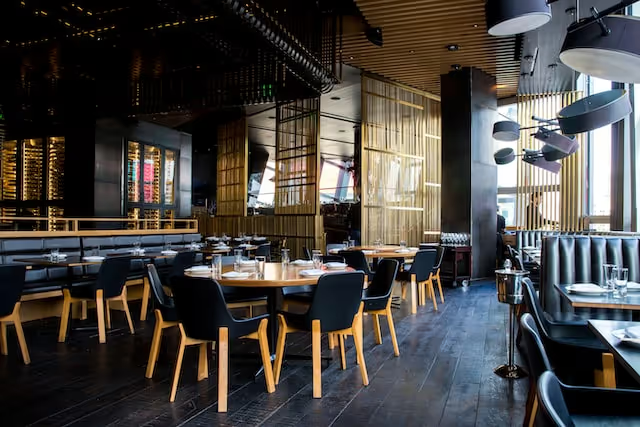
- What atmosphere (retro, rustic, vintage, chic) do you want to create in your restaurant?
The answers to these questions will allow you to create a unique visual identity to make an impression and stand out from your competitors.
Create the restaurant business plan
Once the concept has been determined, you must draw up a business plan. This roadmap will allow your contact (banker, investor) to understand the potential, seriousness, and viability of your project. In other words, this is a key step in your journey as a restaurateur.
Since each project is unique, there is no one-size-fits-all business plan template. However, there are some common and essential elements to incorporate when writing it. This written document must contain at least:
- The executive summary (or operational summary) which highlights the key points of your project;
- The presentation of the project leader(s), their qualifications, skills and experience;
- The presentation of the products or services offered;
- Data based on market research (potential customers, suppliers, existing competitors);
- The chosen commercial strategy;
- Financial forecasts: composed of various tables, including the projected income statement, the projected balance sheet, the financing plan, the cash flow budget, the important financial indicators (self-financing capacity, debt ratio, profitability rate);
- The stages of project deployment;
- An anticipation of the return on investment.
Good to know: there are several types of organizations that can help you develop your business plan; the best known being the consular chambers (Chamber of Commerce and Industry, Chamber of Trades and Crafts) and associations supporting creators (Réseau Initiative France, Réseau Entreprendre).
Choosing the legal status of the restaurant
When creating your restaurant, you will have the choice between different legal statuses: SARL (Limited Liability Company), SAS (Simplified Joint Stock Company), EI (Individual Enterprise), EURL (Single-Member Limited Liability Company) or SASU (Single-Member Simplified Joint Stock Company).
Do you want to open a restaurant with several partners? The most appropriate legal statuses are those of the SARL and the SAS. Most often, restaurateurs choose to create their restaurant as an LLC. The partners' liability is limited to the amount of their contributions to this type of company. In other words, creditors can only seize the company's assets and do not have access to the partners' personal assets. However, this legal status is highly regulated by law. The French Commercial Code sets its operating rules, which leaves little room for the partners to tailor a business. Unlike the LLC, the SAS offers contractual freedom. The founding members can define the management method of their company (appointment of general managers or other optional management bodies) and determine the conditions for the entry and exit of partners (partner exclusion clause, share transfer approval clause, etc.). This legal form is suitable for creating a restaurant chain.
Do you prefer to open and manage your restaurant alone? In this case, you can operate as a sole proprietorship. This legal status has the advantage of being relatively informal. In practice, there is no need to deposit share capital or draft articles of association. In addition, the incorporation process is simplified. To create your sole proprietorship, you simply need to compile a file and submit it to the Business Formalities Center (CFE). After receiving the file, the CFE will send the supporting documents to URSSAF (Union for the Collection of Social Security and Family Allowance Contributions) and the business tax authorities. This legal status is suitable for fast food or takeaway restaurants.
Another option for setting up your own business is to create an EURL (Single-Limited Limited Liability Company) or a SASU (Limited Limited Liability Company). The differences between these two companies are based on operational flexibility; the EURL is the sole proprietorship form of the SARL and the SASU is the sole proprietorship form of the SAS.
It is important to know that there is no ideal legal status for opening a restaurant, strictly speaking. It all depends on the scope of your project, your expectations, and your needs in this area. Don't hesitate to seek the help of an accountant or lawyer who will simplify the formalities of setting up your business.
Choosing the location of the restaurant
The geographic location of your restaurant is essential. This location will determine the development of your reputation and the achievement of your profitability objectives. That's why it's recommended to pay particular attention to certain points.
The Neighborhood
Depending on your target audience, you should prioritize certain urban areas over others. For example, if you're targeting a professional clientele, it's a good idea to locate your restaurant near an office park or in a business district. Conversely, if you're looking to attract a student clientele, a location near a university campus is an excellent option. Once you've defined your preferred geographic area, you can ensure it's attractive enough for your future customers. To do this, you can inspect the premises during the day as well as at night, weekdays and weekends.
Visibility
To maximize your chances, choose premises with sufficient visibility. Note that street corners are particularly attractive locations for restaurateurs.
Accessibility
Think about your target consumer and how they will be able to access your business (presence of public transport, public parking, private parking areas).
Complementary structures nearby
Local tourist offices and hotels can, through a strategic partnership, help attract customers to your restaurant.
Carry out the administrative procedures
Opening a restaurant involves completing numerous administrative formalities. Here are the main steps to follow:
- Establish the company's articles of association by notarial deed or private deed;
- Register the company with the Trade and Companies Register (RCS);
- Publish a notice of incorporation in a legal notices journal in the department where the head office is located;
- Create a professional bank account to be able to deposit the company's share capital;
- Choose a contribution auditor if the partners are contributing assets other than money;
- Submit a request to open a restaurant to the town hall of the municipality where it will be located, at least 15 days before the opening date.
In addition, you must Also think about:
- Carrying out the procedures related to commercial lease rental if you choose to rent premises;
- Subscribing to professional insurance (professional liability insurance, multi-risk professional insurance);
- Choosing the right tools to manage your restaurant with complete peace of mind (staff scheduling tool, cash register software, payment terminal, etc.).
Following the mandatory training courses for opening your restaurant
Certain specific training courses must be followed before opening your business.
To sell alcohol in your restaurant, you must first follow training in order to to obtain an operating license. This mandatory training course lasts 20 hours (spread over two and a half days) for new operators and 6 hours for people with more than 10 years of experience in operating a liquor store. The training aims to raise awareness among operators about the fight against alcoholic beverages, the protection of minors and the various risks associated with alcohol consumption (drunkenness in public, noise pollution and other public order disturbances). The operating license obtained at the end of the training is valid for 10 years. Beyond this period, a six-hour training course is required to renew the license.
License to sell alcoholic beverages at night
Any restaurant owner wishing to sell alcoholic beverages between 10 p.m. and 8 a.m. must complete a specific training course called PVBAN (License to sell alcoholic beverages at night). This course takes one day and lasts 7 hours. It makes future operators aware of the legal provisions relating to the sale of alcohol during nighttime hours. Like the operating license, the PVBAN license is granted for a period of 10 years. After this period, it must be renewed via a knowledge update program.
Training in good hygiene practices for people handling food
Since October 1, 2012, commercial catering establishments must have someone who has received training in hygiene and food safety, also known as HACCP training. This 14-hour course provides the essential foundations and prerequisites for food safety. The certificate obtained during this training must be presented to the inspector in the event of an inspection.
Good to know: failure to comply with this obligation may result in a warning, a report, and in the worst case, the closure of the establishment if the health of consumers is endangered.
Discover in more detail what HACCP standards in the kitchen consist of.
Plan a marketing plan to announce the restaurant's opening
To successfully open your restaurant, you must implement a marketing strategy. This can range from simple offline communication (distributing flyers on the street or in mailboxes, placing a billboard in front of your restaurant, advertising in local newspapers), to implementing digital promotional actions (communication on social networks, creating a Google My Business page, optimizing your restaurant's profiles on specialized portals such as LaFourchette and TripAdvisor) and participating in various events (festivals, highlights, and local celebrations).
Find out about the support available for opening a restaurant
There are many support schemes for setting up restaurants. Below is a non-exhaustive list of the aid you may be eligible for:
- Aid for Business Creators and Buyers (ACRE): this aid for business creation takes the form of a partial or total exemption from social security contributions (health insurance, maternity, disability, death, basic pension, old age, family allowances) for one year. It can be combined with other financial aid such as NACRE.
- New Support for Business Creators and Buyers (NACRE): this scheme is aimed at young people aged 18 to 25, employees taking over their struggling business, and those receiving minimum social benefits. It consists of support for the start-up and development of the restaurant (assistance in setting up the project, support for financing the project, support for the development of the business) which can last up to 3 years.
- Aid for the Resumption or Creation of a Business (ARCE): this aid granted by Pôle emploi allows you to receive your unemployment benefits in the form of capital. Its amount is 45% of the remaining unemployment benefit rights due on the day the business is created (amount from which a 3% contribution is deducted for the financing of supplementary pensions).
- The honor loan: this is aimed at anyone with a business creation project, regardless of their social or professional situation. The particularity of this loan lies in the fact that it is granted without guarantee or personal surety. It is, in fact, a zero-interest credit. Its amount generally ranges between €3,000 and €50,000.
- Various regional aid (subsidy, initiative grant, advice voucher, digital voucher, etc.): check with your region to find out about all the schemes in force.
Now you know how to open a restaurant! All you have to do is make your project a reality.